Wednesday, September 26, 2018

Monday, September 24, 2018
Go SOLO 91262(2.7) Calculus

Achievement
|
Understand the relationship between a function (equation) and the
* graph of the gradient function (derivative)
* area between the graph and the x axis (integral) |
Understand the symbols dy/dx, f’(x), f"(x) and
 dx dx |
Differentiate expressions that have integer exponents like 3x2 and 4/x2
|
Find the gradient at a given point of a graph if given the equation of the graph
|
Find the point on a graph that has a given gradient if given the equation of the graph
|
Integrate expressions that have integer exponents like 3x2 and 4/x2
|
Find the equation of a curve if I am given the gradient function
|
Merit
|
Find turning points
|
Identify what type of turning point and when a function is increasing or decreasing
|
Find the equation of a tangent to a curve
|
Solve kinematics problems (velocity, acceleration)
|
Interpret my solution into words related to the problem
|
Excellence
|
Optimisation problems
|
Kinematics
|
Rates of change
|
Form equations for optimization and area problems, kinematics and rates of change
|
Friday, September 21, 2018
Plan
As 91262(2.7 ) Apply calculus methods in solving problems
Achievement
|
with Merit
|
Achievement with Excellence
|
||
· Apply calculus methods in solving problems.
|
· Apply calculus methods, using relational thinking, in solving problems.
|
· Apply calculus methods, using extended abstract thinking, in solving problems.
|
||
I have been working my way through Calculus (2.6, External) with my 12MAC class.
I chose 3 Maori students.
I made the following planning decisions:
I used the check, chunk and chew technique to recognize find the gradient if a function at
a given ‘x’ value, Sketch the gradient function, Given the derivative f’(x) and a point (x,y),
find the original function f(x).
I decided to spend more time Find the equation of the tangent line, Find a point on a curve
when given a gradient, Find the coordinates of the turning points on a graph, Find the rate
of change of a function at a given time, Find the maximum/minimum values of a given
function, Kinematics problems – finding speed from a distance function, Find the function f(x)
when given f’(x) is given.
And optimizing applications – using calculus to find the maximum. Use the second derivative to determine the nature of turning points, Identify the ‘x’ values where a function is increasing or decreasing, Kinematics problems – finding the distance from a speed function. This will be useful for merit and excellence questions.
(1) I have started after school Friday after school to give more one to one support to students in order to improve their External results.
(2) Also at the end of the topic, they sat Mock Examinations.
Reflection As91261(2.6) Algebra(External)
According to the students’ feedback, most of them found the Achieved questions straightforward but found the Merit and Excellence questions in a contextual based situation quite difficult. This was reflected in their Mock examination results. So, I am going to continue helping them after school on Friday and during the term3 break. I. I am now looking forward to the external results.
As91261 Algebra Revision for Mock Examination
My students and I planned this term(3) very carefully to avoid the last
minute rush. We finished the 1/3 of the Algebra after the last internal(2.14)
and made them to practice past papers for homework. Here is the video.
GO SOLO As91261(2.6) Algebra
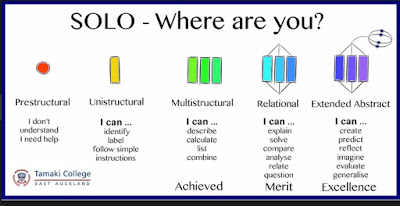
Achieve
Apply algebraic methods in solving problems:- selecting and using methods
- demonstrating knowledge of algebraic concepts and terms
- communicating using appropriate representations.
Manipulate algebraic expressions
Expand brackets up to 3 factors
Factorising expressions including quadratics
Use fractional and negative indices
Change the subject of the formula
Use elementary properties of logarithms
Simplify rational expressions.
Expand brackets up to 3 factors
Factorising expressions including quadratics
Use fractional and negative indices
Change the subject of the formula
Use elementary properties of logarithms
Simplify rational expressions.
Solve equations involving.
Multi-step linear equations or inequations, eg 3(2x − 5) = 5x + 7
Quadratics that can be factorised eg 2x2 − 11x = 21
Polynomials in factorised form eg 3x2(x − 7)(2x + 6) = 0
Simple logarithmic and exponential eg Log2x = 2, 2x = 64
Forming and solving linear/linear simultaneous equations.
Multi-step linear equations or inequations, eg 3(2x − 5) = 5x + 7
Quadratics that can be factorised eg 2x2 − 11x = 21
Polynomials in factorised form eg 3x2(x − 7)(2x + 6) = 0
Simple logarithmic and exponential eg Log2x = 2, 2x = 64
Forming and solving linear/linear simultaneous equations.
Merit
Relational thinking involves one or more of:
- selecting and carrying out a logical sequence of steps
- connecting different concepts or representations
- demonstrating an understanding of concepts
- forming and using a model;
and also relating findings to a context, or communicating thinking using
appropriate mathematical statements
Solve problems involving equations.
Assessment will be based on a selection from:
- quadratics requiring the use of the quadratic formula
- linear/non-linear simultaneous equations
- exponential eg 134x-5 = 6.
non-linear equations may be given as appropriate to the complexity of the problem.
Students will be expected to solve problems in context.
Assessment will be based on a selection from:
- quadratics requiring the use of the quadratic formula
- linear/non-linear simultaneous equations
- exponential eg 134x-5 = 6.
non-linear equations may be given as appropriate to the complexity of the problem.
Students will be expected to solve problems in context.
Excellence
Extended abstract thinking involves one or more of:
- devising a strategy to investigate a situation
- identifying relevant concepts in the context
- developing a chain of logical reasoning, or proof
- forming a generalisation;
and also using correct mathematical statements, or communicating
mathematical insight.
Choose algebraic techniques and strategies to solve problems.
Where appropriate, interpretation of a solution will be expected and
Where appropriate, interpretation of a solution will be expected and
may involve the nature of the roots of a quadratic.
Subscribe to:
Posts (Atom)